Sit in almost any project meeting and you will hear "quality assurance" and "quality control" used as if they were the same thing. They are not. The mix-up makes sense, because both want the same result: software people can trust. But they work at different moments and ask different questions. One shapes how the work gets done before anything ships. The other checks what comes out at the end. Once you see the gap, you plan, hire, and react to problems differently.
That difference reaches far past software. Think of the digital services we use daily — banking apps, streaming libraries, or a smoothly run platform like rollambia, where players expect every spin, payment, and page load to just work. Behind that calm surface, two separate disciplines work side by side. When a team holds the difference clearly in its head, the whole operation runs with less friction and far fewer late-night surprises.
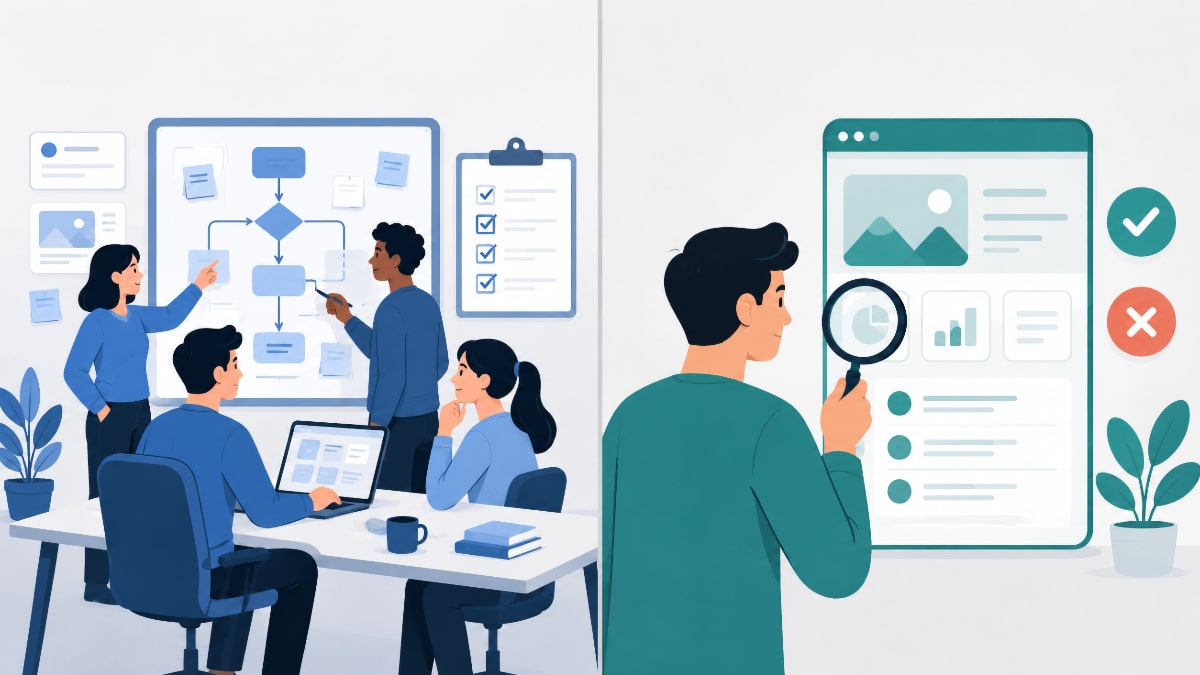
Two terms that keep getting tangled up
Some of the confusion is just history. People shorten quality assurance vs quality control to "QA" in everyday talk. Suddenly the tester poking at a release and the engineer who designs the review process share one label. They are not doing the same job.
Here is a simple way to keep them apart. Assurance is about the process. Control is about the product. Assurance asks whether your way of building things is sound. Control asks whether the thing you built is good enough. You need both, and one never replaces the other.
Teams that treat the two as the same usually overfeed one and starve the other. Heavy inspection without process discipline means catching the same bugs forever. Strong process without inspection means trusting that nothing ever slips through. Something always does.
Quality assurance is about preventing problems before they start
Quality assurance looks ahead. It lives in the choices a team makes long before code reaches a user: coding standards, review habits, a shared definition of done, and the automated checks that run on every commit. The point is to build quality in, so defects have fewer places to hide.
It helps to picture what assurance actually touches in a normal week. These are the quiet routines that keep standards steady:
- Agreeing on coding conventions the whole team follows
- Reviewing each other's pull requests with real attention
- Writing tests alongside features, not weeks later
- Describing how a feature should behave before building it
- Running continuous integration on every change
- Using retrospectives to fix the process, not just the bug
Notice that none of these steps inspect a finished product. They shape the conditions the product gets built in. That is the core idea: change the system, and you change what comes out of it.
Quality control and the art of catching what slips through
Quality control reacts, and that is not a criticism. It is the safety net. Once a feature exists, control checks it against expectations — functional testing, exploratory sessions, regression runs, and the final sign-off before release. Assurance stays invisible. Control is something you can point to, because it gives you clear pass and fail results.
The two disciplines pass work back and forth all day. Set them side by side and the split gets easier to see.
| Aspect | Quality Assurance | Quality Control |
|---|---|---|
| Focus | The process | The product |
| Timing | Before and during work | After work is built |
| Goal | Prevent defects | Detect defects |
| Mindset | Proactive | Reactive |
A finished build still needs a clear-eyed second look. That is where the next thought comes in.
„You cannot inspect quality into a product.“ Deming's warning still lands: control on its own, with no assurance upstream, only tells you how much you already got wrong.
Good control work takes more imagination than people expect. A sharp tester does not just run a script. They picture how a real person might misuse a screen, then go looking for the crack.
Where the line blurs in fast moving digital products
In modern delivery, that neat boundary softens. With continuous deployment, a change can travel from a laptop to live users in minutes. Prevention and detection end up running almost together. Automated tests blur the roles too: writing them is assurance, running them on a build is control.
Busy digital platforms feel this strain the most. Here is what is really at stake when quality slips in a few familiar product types:
| Product type | If assurance is weak | If control is weak |
|---|---|---|
| Payment app | Fragile, risky releases | Wrong balances reach users |
| Streaming service | Recurring playback bugs | Broken episodes go live |
| Online gaming site | Unstable new features | Visible glitches during play |
| Booking platform | Slow, error-prone updates | Double bookings slip through |
The point is not that one column wins. Weakness in either one reaches the user sooner or later. A platform can hire brilliant testers and still ship constant fixes if its process is chaotic. It can write flawless process documents and still embarrass itself if nobody checks the final build.
„Trust takes years to build, seconds to break, and forever to repair.“ For any service people pay to use, that line is the real business case for taking both disciplines seriously.
Building a culture where both quietly do their job
The healthiest teams stop fighting over who owns quality. They accept that everyone does. Developers practise assurance whenever they write a clear test. Testers practise control whenever they question a finished feature. Managers practise both when they protect the time these things need.
A few habits tend to separate teams that ship with confidence from those that ship with crossed fingers:
- Treat reviews and standards as real work, not overhead
- Keep a fast, trustworthy automated test suite
- Let testers explore, not just tick boxes
- Track where defects escape, then fix the process behind them
- Talk about quality before a deadline, not after an incident
Once these habits feel normal, the difference between assurance and control stops being an argument and becomes a rhythm. Prevention and inspection take turns. Each one covers the other's blind spot.
Quality assurance and quality control are partners, not rivals. One keeps the process honest. The other keeps the product honest. Confuse them and you will neglect one of them. Respect the difference and you get something rare: software that feels dependable by design, not by luck. That quiet reliability is the thing users notice least and trust most.